Years ago when I read James Mitchner’s “Hawaii” I was impressed
by the part that dealt with the leper colony which was contagious. Today, Hansen’s Disease, as the preferred name, is curable. So great was the fear of contraction Hansen’s Disease that, in Hawaii, those with the disease were sent to Kalaupapa on the Hawaiian
island of Moloka’i. Kalaupapa was isolated as it was a projection of land bounded by a high sea cliff and the pounding ocean thus making it nearly inaccessible. When I was on Molokai I did not visit Kalaupapa, now a National Park, and now wish I had. There are two ways to get there, on a prearranged tour down a 3.5-mile treacherous trail on a mule or flying in but that costs several hundred dollars. Guess that’s why John and I didn’t go. I contented myself to looking down on the settlement and reading the sign boards atop the sea cliffs.
Saint Marianne Cope of the Order of St. Francis is also known as
Saint Marianne of Moloka’i. I recently visited the Saint Marianne Cope Shrine and Museum in Syracuse where I learned about her dedication to those banished to Kalaupapa. In 1883, Sister Cope received a plea for help caring for the leprosy sufferers from King Kalakaua. More than 50 religious groups had declined but not Cope . She replied, “I am not afraid of any disease, hence it would be my greatest delight even to minster to the abandoned lepers.” In October of that year Cope and six sisters left Syracuse for Hawai’i. One was Sister Leopoldina who chronicled their time helping lepers. Not one of the sisters contracted leprosy.
The sisters took the train to California then a week-long sea trip to Hawaii. Sr. Marianne was very seasick, which is probably the reason she never left the islands. In Maui she founded St. Anthony’s Schools and the island’s first hospital. It must have come naturally because she was instrumental in opening two of the first Catholic hospitals in Central New York: St. Elizabeth’s Medical Center in Utica and St. Joseph Hospital Health Center in Syracuse.
In 1888 the sisters moved to Kalaupapa to care for those with
Hansen’s disease. In addition to bringing professional hospital care she sought to improve the patients’ quality of life by treating them with dignity and respect. The Saint Marianne Cope Shrine and Museum has excellent displays dealing with her life, her time in Hawaii and her road to sainthood. Displays included her trunk, desk and Sister Leopoldina’s journal relating their time at Kalaupapa. She took charge of the home Father Damien had established for men and boys. She introduced cleanliness, pride and fun for the people. Bright scarves and pretty dresses for the women and games for the children was part of her approach. Today there are only a few permanent residents.

Her life is inspirational. I am in awe of anyone who dedicates their life to a cause that benefits mankind. She said, “Let us make the very best use of the precious moments…” and “What little good we can do in this world to help and comfort the suffering, we wish to do it quietly and so far as possible unnoticed and unknown.” Her work did not go unnoticed or unknown. Marianne Cope died in 1918 and was beatified in 2005 and canonized in 2012. Her reliquary at the shrine is flanked by feathered standards of honor reserved for Hawaiian royalty.
Tora! Tora! was the Japanese code-word made famous when the Japanese attacked Pearl Harbor on December 7, 1941 propelling the United States into World War II. The term means “tiger” but in this case it was an acronym meaning “lightning attack.” On December 11, 1941, President Franklin Roosevelt declared war on Japan; in return, on the same day Germany and Italy, Japanese allies, declared war on the United States.
Visiting Pearl Harbor on the Hawaiian island of Oahu is a profound experience and visitors should plan to spend the better part of the day there because there is a lot to see and do. The main attraction is the USS Arizona Memorial with an informative 23-minute movie followed by a boat ride to the USS Arizona Memorial which is built atop the ship that is the final resting place for 1,177 of the USS Arizona’s crewmen. It was the greatest loss of life on any US warship in American history. The names and ranks of the crewmen are listed on the memorial wall. There were 37 sets of brothers on

board that fateful day. Nearby in the water are memorials to the other ships destroyed on that Day of Infamy. When the USS Arizona sank there were more than a million gallons of fuel on board. Some of it still surfaces. Survivors have called the oil droplets “Black Tears.” It helps to get USS Arizona tour tickets on line; however, the National Park Service gives out over 2000 free walk-up tickets each day on a first come basis. The tour of the USS Arizona take about two hours but there is much more to see there.
For Americans the Pearl Harbor attack was the beginning of World War II but the war had already started in Europe with the German invasion of Poland in 1939 and in Asia the fighting started when the Japanese invaded China in 1937. The formal end of the WW II took place on the deck of the USS Missouri in Tokyo Bay on September 2, 1945 and was broadcast
throughout the world. Gen. MacArthur said, “Let us pray that peace be now restored to the world and that God will preserve it always. These proceedings are closed.” Today the USS Missouri is at anchor in Pearl Harbor. Nearby on Historic Ford Island is the Pacific Aviation Museum with two hangers of exhibits.
The attack on Pearl Harbor was intended to prevent the US Pacific Fleet from interfering with the Japanese plan to take over other areas in the Pacific. Many people do not realize that the attack on Pearl Harbor was part of a greater offensive. On the same day (it was December 8 in Asia) they were simultaneous Japanese attacks on the US-held Philippines, Wake Island, and Midway Island; plus, there were assaults on Singapore, Malaysia and Hong Kong. The Japanese did not occupy the island
of Oahu like they did the other places they attacked which led to the people in those areas suffering from Japanese occupation much the same as those in China. Interestingly, Hawaii and the Philippines, prior to December 1941, were considered great places to be stationed. We learned more at the US National Parks in Guam and Saipan, plus the WW II museum in Singapore. At the National Museum of the Pacific War in Fredericksburg, Texas they have a realistic battle reenactment several times a week.
If I was going to move to Hawaii, which I am not considering, I would pick the island of Molokai. When John and I left the airport in our rental car we liked the sign that said, “Aloha, Slow Down this is Moloka’i. No windmills or cables.” They like to say that the island is a step into the 50s and they want it to stay that way. For some, especially the young people, it is just too quiet. For us it was perfect.

Molokai is Hawaii’s fifth largest island and only 38 miles long and 10 miles wide. There are less than 8,000 inhabitants and nearly half are of Hawaiian descent so it is called “The Most Hawaiian Island.”
We rented Condo 207 at Molokai Shores. It was lovely with a
kitchen, bedroom, living room, and a balcony. We had access to the beach, swimming pool, and laundry; and, as one might expect, very quiet. We went shopping in the one main supermarket. They had everything but things are expensive because it is an island and everything has to be imported. Molokai is always quiet but even more so on Sunday when most things are closed. Even on week days there is very little traffic so exploring the island is stress free.
 We would have liked to visit Kalaupapa National Historical Park which preserves the leper colonies that were established in the mid-1800s to isolate those with leprosy (better known as Hanson’s disease). I recall reading about it in James Michener’s epic, “Hawaii.” The disease has been curable since 1940 but some people still remain in the settlement. It is where Father Damien, Hawaii’s first saint, dedicated his life to improving the conditions of those afflicted.
The settlement is on a spit of land surrounded by the world’s highest cliffs. There are two ways to visit. One is to fly in on a helicopter and the other by mule down the cliff trail. We decided to opt for a view from above. We drove to the Kalaupapa Lookout where a short trail led to an area with a view overlooking Father Damien’s settlement. Storyboards told about the colony.
We would have liked to visit Kalaupapa National Historical Park which preserves the leper colonies that were established in the mid-1800s to isolate those with leprosy (better known as Hanson’s disease). I recall reading about it in James Michener’s epic, “Hawaii.” The disease has been curable since 1940 but some people still remain in the settlement. It is where Father Damien, Hawaii’s first saint, dedicated his life to improving the conditions of those afflicted.
The settlement is on a spit of land surrounded by the world’s highest cliffs. There are two ways to visit. One is to fly in on a helicopter and the other by mule down the cliff trail. We decided to opt for a view from above. We drove to the Kalaupapa Lookout where a short trail led to an area with a view overlooking Father Damien’s settlement. Storyboards told about the colony.
On our return we stopped at the Meyer Sugar Mill which is on the National Register of Historic Places. There is a small museum. They will also organize a Pa’ina (the Hawaiian word for luau) with a hula dancer. Molokai is where the hula originated. We also took the road west across the middle of the island. The coffee shop that advertised free music was closed so we continued on to the

town of Maunaloa seeing nary a soul. The village is quaint and the center of attraction was the Big Wind Kite Factory which offers handmade kites along with classes for kids. The owners Daphne and Jonathan started the Big Wind Kite Factory in 1980 and all the kites and windsocks are handmade in the back of the shop. The gift shop has a fascinating collection of artifacts and gifts from around the world.
For a place with such a small population there are several small but attractive places of worship. As one might expect there is snorkeling, fishing, surfing and other water fun activities. Hiking in Halawa Valley, which was settled by Polynesians around 650 AD, is a popular activity especially to the double-tiered 250-foot Mooula Falls. We found Molokai a great place in which to kick back.
When John and I were in Hawaii we wanted to see as many of the islands as possible and we found the perfect way to do it on the Un-Cruise Safari Explorer. Un-Cruise allowed us to visit four islands and all the tours were included. It was a luxury cruise without the glitz. Shorts, swimsuits and T-shirts were the preferred attire. The Safari Explorer can accommodate 36 passengers but there were only 23 on our seven-night cruise which made the experience more desirable. Our room had a queen size bed, A/C, and ensuite bathroom plus sliding glass doors with a great view of the sea and islands.
The crew was a fountain of information about the history of the islands and the denizens of the sea plus they used local people to add to our understanding of the island and sea creatures. One evening Katie, from Kona Diving Company, came aboard and gave an informative presentation on manta rays. They have no teeth but funnel food into their mouth using the two large flap-like
lobes. After the presentation it was time to shimmy into our wetsuits for an exciting night snorkel with the mantas. Watching these huge rays doing belly rolls was like being part of a
National Geographic special. I saw slate pencil sea urchins (first time) along with Yellow Tang, Achilles Tang, Banner fish, Pink Tail Trigger fish, Orangeband Surgeon Fish, Butterfly Fish, Sergeant Major fish, humu-humu-nuku-nuku-a’pua’a – Hawaii’s state fish also known as the Picasso Triggerfish. When we returned mango margaritas where waiting.
Another day we headed out on the skiff with our group and went
snorkeling above the sea turtle’s “cleaning stations” where the surgeon fish were cleaning the algae off the turtles. The guide put
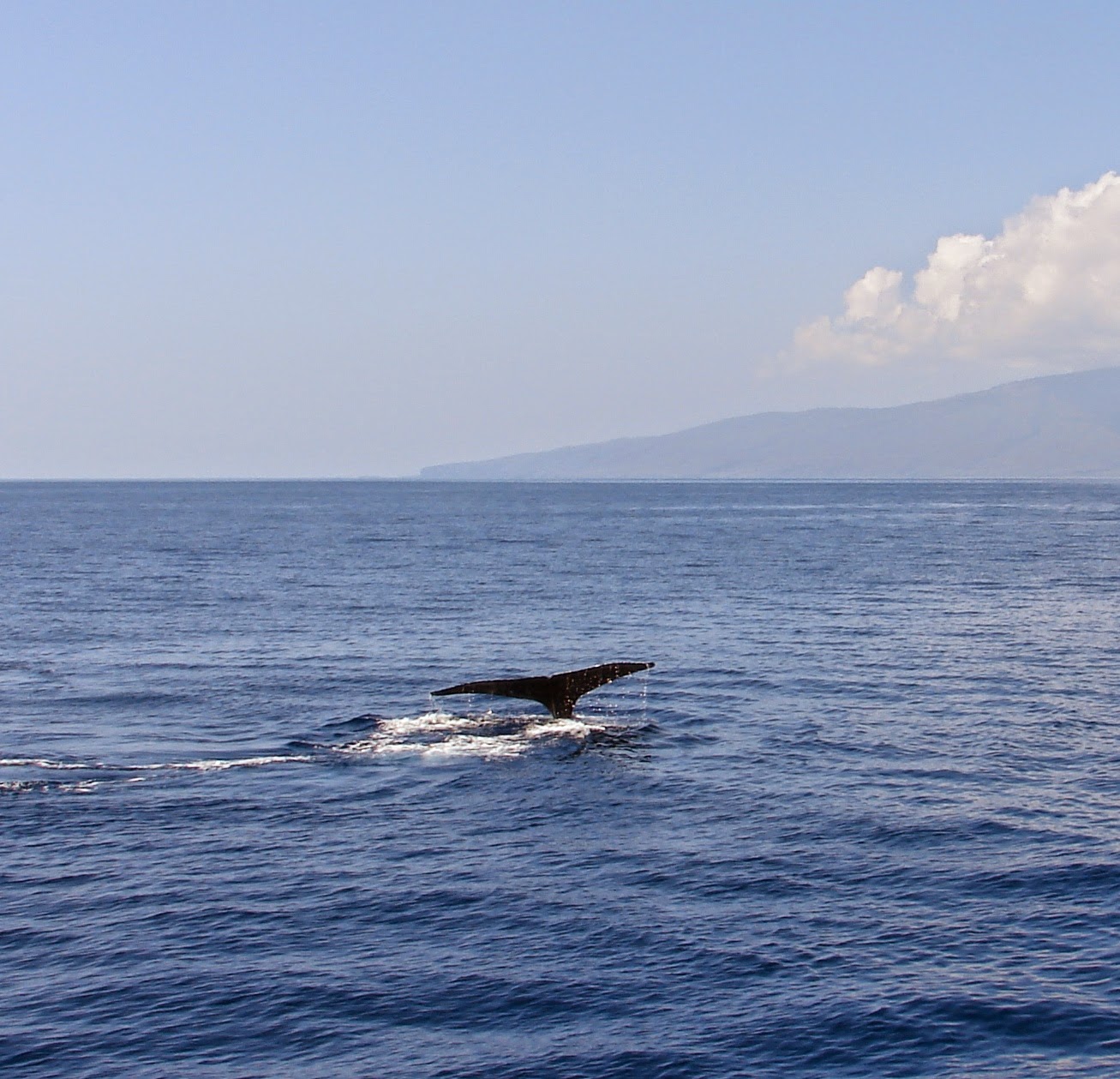
a microphone in the water to listen to whales but mostly we heard the crunching sound of the parrot fish gnawing on the coral and then expelling sand. Nearly every day we saw dolphins and humpback whales. Watching whales breach is awe inspiring. A few had their newborns with them.
Most days included a shore tour. In Lahaina on Maui there was the weekly handicraft market under the 100-year-old spreading banyan tree. I visited the Cultural Heritage Center and learned more about the local culture. One of my favorite shore trips was to the island of Molokai. The island is a step back into the 1950s with no fast
food joints, no stoplights and virtually no people. Our tour took us to Halawa Valley where we met Anakala Pilipo who invited us into the valley with a “honi,” the traditional greeting of touching noses and foreheads. Pilipo’s family has been living in the valley for 50 generations, the longest continuous civilization known in Hawaii.
All meals were gourmet and Chef Nate prepared fish that I loved which is saying something because I seldom eat fish. The day was packed with so many great activities that I didn’t have time to enjoy the alfresco hot tub or teak chaises on the bridge deck but it was a favorite place to enjoy a glass of wine while watching the sunset. I confess I did not get up in the morning for the yoga class and didn’t have time for my free spa treatment. Some of my fellow passengers had taken the Un-Cruise Alaskan Adventure and others signed up for future cruises. I’d like to do the Baja Peninsula cruise someday.
Given the many places we have visited people were often
surprised when we told them we had never been to Hawaii. Well, we have rectified that situation! In fact, our son rented a house for a week in Laie for 10 family members. It had a great view. Those who wanted to fish could walk down the road and fish off the rocks. Those who wanted to swim had just a short walk to one of two beaches. There was something for everyone.
Laie is not far from the Polynesian Cultural Center where we spent the day. Actually, we could have spent two days there because there was so much to see and do. The Polynesian Cultural Center offers a trip to “villages” in Tahiti, Fiji, Tonga, Hawaii, New Zealand, and Samoa where visitors can learn about the various cultures and participate in a variety of activities. Each “village” had a 30-minute cultural presentation plus hands-on traditional craft making and/or a game to learn. We had a good spot along the “river” at 2:30 to watch the colorful canoe pageant where each “village” was represented by a float of dancers and musicians.

When the canoe pageant was over we went to the Hukilau Theater for a video overview of Hawaii’s scenery, food and culture. At 5 p.m. we walked over to the Hale Ku’ai Restaurant for a fabulous luau complete with a pig roasted in the traditional fashion. After dinner there was just enough time to amble over to the evening show, “Ha: Breath of Life,” which is a circle of life story with fire, song, dance and special effects with a cast of 100.

Another day 10 of us went to The World War II Valor in the Pacific National Monument, the place to learn about the beginning and end of World War II. We arrived early and were lucky to get tickets to see the USS Arizona Memorial later in the day. Most days the free tickets are gone by nine. We had time to take a shuttle bus to the recently refurbished battleship USS Missouri on Ford Island. The Missouri is where Japan’s official surrender to the United States that ended World War II took place. Some of our family toured the battleship but John and I had toured many battleships so we viewed the displays outside of the ship and then took the shuttle to the Pacific Aviation Museum. There are two hangars filled with
airplanes. At the assigned time we all met at the Pacific Memorial
Theater to view the 23-minute documentary that relates the December 7, 1941 attack on Pearl Harbor that led to the United States declaring war on Japan. I noticed that some visitors without tickers came as standbys and also got in. Not sure how they knew enough to do that. After the video a short boat ride took us to the Memorial built over the sunken Arizona which is basically the graveyard for 1,102 who died when the Japanese attacked. It was a solemn experience.
Our rental house was near the north shore where the waves are great for surfing and people stop to watch the waves and surfers. A couple of family members took a surfing lesson. While they were learning to surf John and I did something “sweeter,” we took a chocolate tour at the Manoa Chocolate Company, a bean-to-bar artisan chocolate company.
 by the part that dealt with the leper colony which was contagious. Today, Hansen’s Disease, as the preferred name, is curable. So great was the fear of contraction Hansen’s Disease that, in Hawaii, those with the disease were sent to Kalaupapa on the Hawaiian
 island of Moloka’i. Kalaupapa was isolated as it was a projection of land bounded by a high sea cliff and the pounding ocean thus making it nearly inaccessible. When I was on Molokai I did not visit Kalaupapa, now a National Park, and now wish I had. There are two ways to get there, on a prearranged tour down a 3.5-mile treacherous trail on a mule or flying in but that costs several hundred dollars. Guess that’s why John and I didn’t go. I contented myself to looking down on the settlement and reading the sign boards atop the sea cliffs.
 Saint Marianne of Moloka’i. I recently visited the Saint Marianne Cope Shrine and Museum in Syracuse where I learned about her dedication to those banished to Kalaupapa. In 1883, Sister Cope received a plea for help caring for the leprosy sufferers from King Kalakaua. More than 50 religious groups had declined but not Cope . She replied, “I am not afraid of any disease, hence it would be my greatest delight even to minster to the abandoned lepers.” In October of that year Cope and six sisters left Syracuse for Hawai’i. One was Sister Leopoldina who chronicled their time helping lepers. Not one of the sisters contracted leprosy.
  The sisters took the train to California then a week-long sea trip to Hawaii. Sr. Marianne was very seasick, which is probably the reason she never left the islands. In Maui she founded St. Anthony’s Schools and the island’s first hospital. It must have come naturally because she was instrumental in opening two of the first Catholic hospitals in Central New York: St. Elizabeth’s Medical Center in Utica and St. Joseph Hospital Health Center in Syracuse.
  Hansen’s disease. In addition to bringing professional hospital care she sought to improve the patients’ quality of life by treating them with dignity and respect. The Saint Marianne Cope Shrine and Museum has excellent displays dealing with her life, her time in Hawaii and her road to sainthood. Displays included her trunk, desk and Sister Leopoldina’s journal relating their time at Kalaupapa. She took charge of the home Father Damien had established for men and boys. She introduced cleanliness, pride and fun for the people. Bright scarves and pretty dresses for the women and games for the children was part of her approach. Today there are only a few permanent residents.