Showing posts with label Michigan. Show all posts

Feb 1, 2016

Learning about Pres. Ford, Art, and Mammoths in Ann Arbor

The Gerald R. Ford Library in Ann Arbor on the University of  Michigan’s campus has the President Ford’s baby book indicating that his birth name was Leslie Lynch King, Jr. He didn’t change his name legally until he was 22. Ford was born in Omaha, Nebraska but was raised in Grand Rapids and graduated from the University of Michigan where he played football. He earned the designation of Most Valuable Player and was offered a position on both the Detroit Lions and Green Bay Packers.  Instead he went to Yale, a life changing decision.

The Ford Library collects, preserves, and makes accessible to the public a plethora of archival material dealing with Ford’s political and personal life. Ford was a well-liked congressman and became vice president under Nixon when Spiro Agnew resigned, then became the 38th president of the United States following Richard Nixon's resignation, in the aftermath of the Watergate scandal. In the lobby there is a permanent exhibit called “The Remarkable Life and Times of Gerald and Betty Ford” that define the tumulus 70s. When Ford took the oath of office as the 38th President, he declared, "I assume the Presidency under extraordinary circumstances...This is an hour of history that troubles our minds and hurts our hearts." 

The University of Michigan can claim to be where the Peace Corps
started.  Well after midnight on Oct. 14, 1960, Senator John F. Kennedy arrived at the Michigan Union after a long day of campaigning for the presidency. In his speech he challenged University of Michigan students to dedicate themselves to global peace and justice by living and working in developing nations—and hundreds responded with signed petitions; from that powerful idea and the action of the U-M students grew the Peace Corps.


While on campus we took time to wander around observing the public. I am not an art aficionado so maybe that is why I was underwhelmed by Maya Lin’s Wave Field which is considering an “an artistic treasure.”  It is a wave of earthen mounds the appearance of which changes as the sunlight casts shadows on it.  Maybe I would be more appreciative if I visited on a sunny day.  I did, however, enjoy touring the University’s Art Museum where I could identify with much of the art. In the magnificent entry way is “Nydia, the Blind Flower Girl of Pompeii’ who led friends through the ash covered city. 

The Museum of Natural History has exhibits on geology, the evolution of life, dinosaurs, and artifacts from human cultures around the world. They are justly proud of their newest acquisition – a recently unearthed mammoth. The mammoth was discovered by a farmer digging to install a drainage pipe.  How exciting that must have been. Mammoths roamed the area 11,000 years ago.  The surface of the molar was the size a print left by a very large man’s shoe. 

Not far from the campus away tucked in a mall is one of my
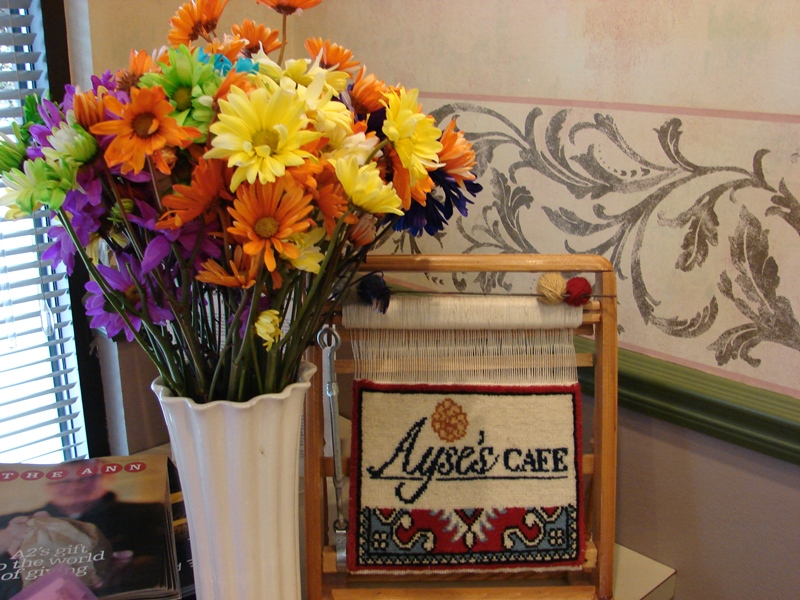
favorite restaurants in the Ann Arbor area, Ayse’ Turkish CafĂ©. Don’t be fooled by the lack of curb appeal the food is awesome.  Think of it as eating at a friend’s house.  Ayse doesn’t have printed menus because she cooks what she likes based on the fresh ingredients she can get but she always has stuffed peppers, my personal favorite. If you have never been to Ayse’s, considering ordering a couple of dishes and sharing them. 

Dec 21, 2015

Lovin' Ann Arbor

I love it when people think out of the box creating an unexpected surprise.  Actually, there were a lot of wonderful surprises when John and I visited Ann Arbor, Michigan. There were great museums, a wonderful diversity of places to eat, amazing artists and galleries, unique shops, live theatrical presentations, and more. I loved the whimsical Fairy Doors. What a cool idea. 

John and I stayed at the new Residence Inn with a great location in the center of Ann Arbor.  Luckily someone said to us, “Make sure you look for the Fairy Doors.” Fairy doors are miniature replicas of the doors to some of the places in Ann Arbor.  Not only are the doors reproduced but with some it is possible to look inside to see a miniature interior. Had we not known to look we would have walked pass them without looking down to discover these treasures.  It seems that the fairy doors
began to appear unannounced in 2005. Like all fairies the ones in Ann Arbor are surrounded in mystery. But the local, fairyologist, Jonathan B. Wright, is the authority on these wonderful miniature art doors.  On Main Street we saw our first Fairy Door at the Peaceable Kingdom, the perfect place for a Fairy Door because the shop is filled with folk and whimsical works of art.  I loved the applique by Chris Roberts-Antieau named “Table Manners” the table manners everyone should follow.

John and I had an amazing lunch at the Blue Nile Ethiopian Restaurant.  This wasn’t our first Ethiopian restaurant so we knew the food would be presented on a large platter with dollops of food on bread called injera, a light sponge-like bread. We would rip off a piece of injera using it to pick up the food.  The
food was awesome.  In the center we had portions of chicken, lamb and beef surrounded by veggies – chick peas, collard green, red lentils and more.  The spiced tea was the best we have ever had. Everything we tried was excellent and not easy to describe. It is said that people who eat from the same plate and break bread together will create a bond of friendship. 

We couldn’t visit Ann Arbor without a side trip to Ypsilanti where our daughter-in-law went to college.  “Ypsi” is only 11 miles away and a great place for antique and vintage shoppers. We stopped at Schmidt’s Antiques on Michigan Ave.  Inside the unassuming red barn was a world of important
antiques of the highest quality.  The most amazing thing were the prices.  Most of them were affordable.  I saw stunning, high-quality dining room table and chairs that cost about the same as a new set that would be of lesser quality.  Antiques are a good buy now. Next to it was the newly opened Muse, a vintage store filled with one-of-a-kind things for the vintage shopper. 

On the way back in Ann Arbor we visited the Hands On Museum that was just a short walk from the Residence Inn.  I love these interactive science museums and don’t think they are only for children.  There were several displays I wanted to “play with” like Google Earth but didn’t feel right pushing the youngsters out of the way.  They actually have an adult-only evening.  Cool! 

One night we attended a concert of Gaelic music at the Ark, just a short walk from our hotel, and noticed another Fairy Door. 

Dec 12, 2015

Flying in a WW II C-47

John and I discovered many wonderful surprises when we visited Ann Arbor, Michigan.  John was thrilled when he found out that he could fly in a WW II C-47.  At the Yankee Air Museum he learned about Michigan’s contribution to aviation history. The airport is situated on property that was also the site of the Ford Motor
Company’s Willow Run Bomber Plant that built 8,685 B-24 Liberator bombers. At its peak it was the largest industrial facility (one mile in length and about a half mile wide) in the world at the time.  Also it was the first aircraft manufacturing complex to use Ford’s automotive mass production method, employing more than 42,000 people and produced a B-24 every 55 minutes. It was dubbed the “The Arsenal of Democracy.” 

The C-47 Skytrain, “The Yankee Doodle Dandy,” was similar to
the civilian DC-3. It was fitted with a cargo door, a strengthened floor, a tailcone for glider-towing shackles and an astrodome cabin roof. It was the workhorse used by many countries during WW II to transport troops, cargo and wounded.  The C-47 was instrumental in the success of most of the campaigns of WW II airlifting supplies in Burma, flying “The Hump,” and later used in the Berlin Airlift.

He toured the museum and met “Rosie the Riveter,” one of the many women who to took the place of men who were off to war. “Rosie” headed the campaign to encourage women to enter the workforce. The morning was foggy so John was afraid that the flight would not happen. Just as they were about to cancel the flight the fog lifted and he boarded the plane. He was strapped in on the bench with his back to the wall just like the WW II paratroopers while the historical interpreter, Tony Pequeno, pointed out the details of the plane and demonstrated the slide cable used by the jumpers.  John said he would not be afraid to jump but not while the enemy was shooting at him. The plane took off and wasn’t as noisy as anticipated and flew smoothly over the area.  An incredible experience. Now John would like to return to take a similar ride on a B-25 and/or a B-17.

While John was flying I had an incredible experience of my own. I took the Motawi Tiles free tour that is offered every Thursday at 11 a.m. I immediately recognized the tiles that were Frank Lloyd Wright and Tiffany inspired but what caught my attention were the
Charley Harper’s cardinals. I am now the owner of one.  All the tiles have the clean simple lines that draw their inspiration from the Arts and Craft movement. During the tour there were people at each station of production to explain their function. I was most impressed with the ladies who were “bulb” painting the tiles.  Motawi makes about 1000 tiles a

day but it takes five days for a tile to be completed. For me the highlight occurred at the end of the tour.  I got to make my own tile. When I finished creating the tile Motawi fired it and then mailed it to me. Awesome. The owner, Nawal Motawi, stopped by. She likes to “make pretty things that affect the lives of others.”  I would say that she has succeeded.  C-47 flights and Motawi tiles are excellent gift ideas. 

May 7, 2012

Learning about the War of 1812


The War of 1812 was fought on land and sea from Montreal to New Orleans and from the Atlantic Coast to the middle of the continent. Remember the War of 1812 with a visit to some of the significant sites many of which have scheduled events commemorating the War of 1812.
  1. Detroit: On August 16, 1812 shortly after the US declared war on Canada and Britain, the British under Mayor General Brock with Native American allies under the Shawnee leader, Tecumseh were able to trick American Brigadier General William Hull into surrendering the fort and town of Detroit, Michigan.
  2. Fort Niagara: On December 19, 1813, British forces invaded the United States and captured Fort Niagara without firing a shot. The British troops and their native allies then burned nearby Lewiston, NY in retaliation for the American burning of the Canadian village of Newark, Ontario, now known as Niagara on the Lake, ten days earlier.
  3. Erie, Pa: In Erie the public dock is named for Daniel Dobbins, a merchant marine, who made the long trek to Washington, DC, where he informed the government that there was a desperate need of more naval power on Lake Erie which led to the creating of a base in Erie. Commodore Oliver Hazard Perry took command of the ship building effort at Erie aiding the American’s control of the Great Lakes.
  4. Oswego, NY: In the Great Lake port city, an estimated 200 men and boys volunteered to transport an anchor rope needed in Sackets Harbor to make the “USS Superior,” a newly built frigate, battle ready. The rope was six inches in diameter, 600 feet long, and weighed about five tons. The H. Lee White Marine Museum recalls the event.
  5. Sackets Harbor: Sackets Harbor was the center of American naval and military activity in the eastern part of Lake Ontario. Visit the Seaway Trail Visitor center to learn about the war along Lake Ontario. Storyboards are located along the Lake Ontario shore where major events happened.
  6. Burning of Washington, DC: On August 24, 1814, the British force led by General Robert Ross occupied Washington and set fire to many public buildings including the White House and Capitol building. It was the last time a foreign power captured a US capital.
  7. The Star Spangled Banner: On September 13, 1814, the British attacked Fort McHenry in Baltimore harbor. During the bombardment, Francis Scott Key was inspired to write the poem, “The Star-Spangled Banner,” which was later set to music and became the national anthem of the United States.
  8. USS Constitution: Sitting in Boston Harbor, the Constitution earned the nickname “Old Ironsides” when she successfully defeated the HMS Guerriere. It was just one of her sea battle victories. The USS Constitution is the world’s oldest commissioned naval vessel afloat.
  9. Canada: There are many sites along the Great Lakes and St. Lawrence River where the battles for control of Canada occurred including York, now called Toronto, Niagara-on-the-Lake, and one of the bitterest battles at Lundy’s Lane, near Niagara Falls.
  10. Battle of New Orleans: Treaty of Ghent signed in present-day Belgium formally ended the war on December 24, 1814 but one of the most famous battles occurred on January 8, 1815 under the command of Mayor General Andrew Jackson. The victory was later popularized in song by Johnny Horton.

Feb 13, 2012

Great train trips


There is something about the mournful sound of a train that calls for one to hop aboard and see the world. Some trains are legendary such as the Alaskan trip from Anchorage to Fairbanks and the Australian Ghan that now goes from Darwin to Adelaide. There are many trains worldwide that offer excellent experiences. Some travel short distances while others cover a whole continent.

1. Denali, Alaska: Maybe you won’t see any of Alaska’s famed wildlife on the ride between Anchorage and Fairbanks but scenery from the double decked dome rail cars will mesmerize as it enters the Nenana River Canyon and crosses the Tanana River on one of the world’s longest single-span bridges.
2. Fort Bragg Smoke Train: The California train chugs through towering trees, tunnels, over bridges and past open meadows on what is known as the “Redwood Route” following the same route it has since 1885. On the Northspur Route a barbecue in the redwood forest is included.
3. Polar Express: Nearly every state has a Polar Express that takes the young and young-at-heart to the North Pole while the book of the same name is read, cookies are served, and songs sung. When it arrives at Santa’s workshop, the jolly fellow boards the train and gives those who believe a bell – just like in the book.
4. Verde Canyon: Located in Arizona near Jerome and Sedona the train runs from Clarkdale to Perkinsville through the walls of Verde Canyon, near ancient Native American sites, with bald eagles watching from their nests.
5. Greenfield Village: Some historic villages have incorporated trains as part of preserving their heritage. Such is the case of Henry Ford’s Greenfield Village in Michigan where visitors can tour the village on a train pulled by one of the village’s historic steam or diesel locomotives.
6. Adirondack Railroad: Hop on board the train in Utica, New York, and head to Thendara through the forests, past pristine rivers, breathing the fresh mountain air while enjoying the beauty of the six-million acre Adirondack Park. Relive the golden age of railroading when the Adirondacks played host to the rich and famous on their way to the Great Camps.
7. Strasburg, Pennsylvania: Ride through Pennsylvania Dutch Country on the Strasburg Railroad that started in 1832. It didn’t purchase its first passenger car until 1861 when President Lincoln made his inaugural train ride to nearby Lancaster and nearly 5,000 people showed up to cheer for Lincoln during his four-minute stop in Leaman.
8. Peru’s Hiram Bingham: One of the most luxurious train trips is aboard the Orient Express train to the mystical ruins of Machu Picchu. The day starts sipping mimosas while watching folk dances followed by gourmet meals with a guided tour of the ruins, along with the excellent service one comes to expect of the Orient Express.
9. The Little Trains of Wales: There are several narrow gauge steam railways in Wales, some of which have been in operation for over 100 years. They have been lovingly restored and maintained. They offer a leisurely ride through the beautiful countryside, past lakes to small picturesque villages.
10. Australia’s Legendary Ghan: One way to get the feel of the immensity of Australia is to take the Ghan between Adelaide and Darwin witnessing the varied landscape and traveling through the vast barrenness of the Outback. The entire trip of nearly 2000 miles takes about 24 hours.

Jul 7, 2011

For lovers of Lighthouses


Aficionados of lighthouses will find them just about everywhere. Not only are they along the coast but also along lakes, rivers, and canals. There are about 1000 lighthouses of various designs in the United States with Michigan having the most with over 150. Some are now automated, others are museums, and some even offer accommodations to the public. The oldest working American lighthouse is the one on Sandy Hook, New Jersey. When it was lit in 1764 it was only 500 feet from the tip of Sandy Hook. Due to changes in the shoreline it is now nearly 1.5 miles from the tip.

1. New York: Tibbets in Cape Vincent is located where the St. Lawrence meets Lake Ontario. The Lighthouse features the only original working Fresnel lens in Lake Ontario. In 1991 the Lighthouse Quarters became part of Hostelling International.
2. Maine: The Nubble Lighthouse in York is a complex of several buildings. Next to the 88-foot tower is the two-story, six-room lighthouse keeper’s house, a workshop, generator building, and the boat house. One unique aspect on the island is the Trolley – a basket on a cable – that allowed goods to be transported to the island.
3. Connecticut: Mystic Seaport Lighthouse is located on the grounds of the Museum of America and the Sea. It is a replica of the Brant Point Lighthouse on Nantucket. The original was built in 1746 and was the second operative lighthouse in New England.
4. New Jersey: Barnegat Lighthouse is known affectionately as ‘Old Barney.’ The name derived from the Dutch word, ‘Barendegat,’ which means ‘inlet of breakers.” It was operational for nearly 100 years. Today visitors can see the original Fresnel lens.
5. South Carolina: The Hunting Island Lighthouse is South Carolina’s only publicly accessible historic lighthouse in the state. At 132 feet high it rewards those willing to climb its 167 steps with breathtaking views of the Hunting Island State Park, the sweeping Lowcountry marshland and the Atlantic Ocean.
6. Florida: Visitors who are more than 44-inches in height may climb the Crooked River Lighthouse. The iron and steel structure guided fishermen and oystermen through the treacherous pass between Dog and St. George Islands, and along Florida's Panhandle for nearly 100 years. The keeper’s house is now a museum.
7. Michigan: Old Mackinac Point Lighthouse was established in 1892, and is located at the southeast end the Mackinac Bridge. It was originally constructed in 1890 to signal fog, with the light being added in 1892. It was deactivated in 1957, and currently serves as a maritime museum.
8. Wisconsin: The Cana Lighthouse was built in 1869 and lit in 1870 and is now a museum. Step inside the Keepers' House where, beginning in 1869, the first of a number of lighthouse keepers tended to the light, which guided sailors and protected them from the dangerous shoals extending out from the island into Lake Michigan.
9. California: The Port Hueneme Lighthouse in Oxnard was established in 1874 to guide shipping through the Santa Barbara Channel which runs between the California coast and the Channel Islands. The two-story Victorian building has a twin at Point Fermin with both being lit on the same day in 1874.
10. And more: There are many lighthouse associations. Some protect one specific lighthouse, others list all those in an individual state, and others are organized by area. The United States Lighthouse Society’s web site, www.uslhs.org, list many of the associations.

Dec 31, 2010

A Locavore Tour of Harbor Country, Michigan


It's trendy these days to be a locavore. A locavore knows where their food comes from and hopefully the source is not far from where they are dining. John and I visited Michigan’s Harbor Country, which is very much like Oswego County. They have built a thriving tourist business based on the locavore concept.

I took the culinary tour that started with breakfast at Kites Kitchen and Retro CafĂ© in New Buffalo. It was not far from the Harbor Grand Hotel where we were staying. Judy Kite-Gosh, the owner, makes everything from scratch. A cheerleader for the locavore movement, she says, “This area has so many microclimates that farmers can grow just about anything.” The Sticky Buns with Caramel Sauce were decadently delicious but surprisingly tasty was the Grass Fed Roast Beef Hash. The beef was raised locally at Middlebrook Farm in nearby Three Oaks – the next stop on my tour.

Middlebrook Farm was established in 1844 but has been owned by Bob and Janet Schuttler since 2005. The Schuttler’s enjoy sitting in their yard at the end of the day with glass of wine. When they first moved to the farm from Chicago they were surprised that there were no fireflies. What happened to them? Too many pesticides was the reason so they try to farm as naturally as possible and the fireflies are back.

No wonder the hash was so delicious. When cattle eat grass like nature planned they thrive producing nutritional and tasty beef. The Schuttler’s raise Lowline Black Angus free of antibiotics, steroids, hormones and pesticides. Schuttler explained that, “They are very docile and will follow me around. Only good things happen when cattle are grass fed. The meat is lower in fat and calories, contains more Vitamin E, and has more Omega-3 Fatty Acids plus there are other benefits.” The Schuttler’s cattle are not only grass fed but are "finished" on grass, rather than fattened up on corn for the last few months prior to processing

The next stop on my tour was Stover’s Farm Market in Berrien Springs. The passion and dedication of the farmers I met was amazing. At Stover’s I enjoyed fresh apple cider and sampled a slew of homemade products but what really impressed me was the barn. The Stover family has been farming in the area since 1870. The huge Big Red Barn was built in 1865 of hand-hewn beams held together by wooden pegs. Not originally located on the farm, the Stovers had it moved three miles to its present location – all 150 tons of it. According to June Stover, “We thought we would knock down people’s mailboxes but the barn rode so high above the road that it went over the mailboxes.” What a sight it must have been.

My next stop on the tour was the Round Barn Winery. Besides wine from their vineyards they brew their own beer and distill their own spirits. Once again what really caught my attention was the barn. The Moerschs, the owners, had a turn-of-the century Amish Round Barn transported from Indiana and rebuilt on their property. Chris Moersch explained, “The historic building is the perfect home for the round copper pot still because only good "spirits" would be created in a structure where legend says that because round buildings have no corners there is no place for evil spirits to hide.”

Nov 8, 2010

Visiting Michigan's Third Coast


John and I had never heard of the “Third Coast” until we planned to visit Harbor Country in Michigan. John had signed up to learn how to surf and paddleboard with Third Coast Surf Shop in New Buffalo. It was on his Bucket List. Surfing on a lake sounds so much safer and easier than surfing in an ocean – no rip tides or sharks. As we were flying over Lake Michigan, John looked down at the lake and commented, “I don’t see any surfers.” He had read in Outside magazine that it was one of the best places to learn to surf.

John’s Surfing 101 Group Lesson started with learning how to the carry the board from the transport vehicle to the beach. The easiest way is on the one’s back. It was fall time and the water was cold even though the weather was nice so he had to don a wet suit. On the beach the class learned the fundamentals of surfing and water safety. The group was instructed how to paddle out by laying on their stomach and how to stand up on the board once they caught a wave – that’s the tricky part. John walked the board out but a wave took it back into the shore so he had to walk to the shore to retrieve it. After several attempts at standing up on the board he found it more fun to ride the wave in on his stomach.

In the afternoon he was off for Stand UP Paddleboarding 101. We had never heard of this sport but I am sure it will show up in more places – places with flat, slow moving water. Paddle boarding started in Hawaii and is a growing sport. It is relatively easy to do with a little practice. The paddle board is essentially an oversized surfboard but a little wider and thicker. It is more stable than an average surfboard. And, it had with a small slot in the middle for easier carrying. Again in his wet suit he set out for a serene paddle on the Galien River near New Buffalo, Michigan. “I really enjoyed the quiet and scenery. A great way to explore a river or lake,” John shared his adventurous day with me while dining at the Stray Dog Bar & Grill.

But the water fun wasn’t over for John. The next day he was up at o’dark thirty to go fishing with Sea Hawks Charter on the St. Joseph River for Chinook salmon, Coho salmon, Steelheads, and Lake Trout with Capt. Clark. “I didn’t catch anything because it was between seasons but I really enjoyed being on the river. It was a beautiful fall day.” After lunch John was back on the Galien River with Ryan Gerard of Third Coast Surf Shop. “This was my favorite day,” John explained when we met up for an wonderful dinner that featured local produce at the Brentwood Tavern, the restaurant at Marina Grand, the sister property of the Harbor Grand where we were staying. “Nothing beats a peaceful day fishing or kayaking on a tranquil river in the fall.”

You might wonder what I was doing while John was having all this water fun. I had my own kind of fun visiting art galleries, local farms, and wineries. Phew, it was tough but someone had to do it!

Sep 11, 2010

Detroit's Woodward Dream Cruise


During the summer I see more and more shiny classic cars of the 50s and 60s on the roadway. When John and I were in Detroit, Michigan John was introduced to a Detroit phenomenon – the Woodward Dream Cruise. It included a ride along Woodward Ave in a classic car. What started as a fundraiser for a soccer field in 1995 has become America’s largest one-day automotive event. The annual event is held the third Saturday in August.

This year on August 21 more than 1.5 million people and 40,000 classic cars from around the world will recreate the 1950s and 1960s along Woodward. The Dream Cruise takes place along a 16-mile stretch of the legendary Woodward Avenue through eight host communities including Berkley, Bloomfield Hills, Bloomfield Township, Ferndale, Huntington Woods, Pleasant Ridge, Pontiac and Royal Oak.

In 1909 Detroit’s Woodward Avenue became the world’s first concrete highway in response to demands for smoother roads by bicyclists and early auto owners. Today, those yearning for the days of drive-ins, bobby socks, and wanting to create their own American Graffiti and Happy Days scenes will find it along Woodward Ave during the Dream Cruise. Hop in your classic car and cruise. There are no fees to drive in the Woodward Dream Cruise or to watch the cruise. Anyone can participate.

Today, just as it was then, the real attraction is the cars. There are hot rods and muscle cars and convertibles and hard tops along with those with oversized tires and custom-painted flames. These marvels of machinery are still “cool” street machines as they cruise along Woodward emanating vintage rock and roll from the AM radio coupled with the rumble of a big block V8.

GM, Ford and Chrysler—The Big Three—all have roots tied to Woodward Avenue. In the cruisin’ era legends grew as the Big Three tested their prototypes on Woodward including the popular the Pontiac’s GTO, Chrysler’s Hemi cars, and Ford’s Mustang. The tradition continues to this day including the latest versions of the Mustang GT, Chevy Camaro and Dodge Charger. They have all made their presence known at the Woodward Dream Cruise.

After the Dream Cruise visit the Henry Ford Museum, the nation’s largest indoor-outdoor history museum. According to the founder, Henry Ford, “I am collecting the history of our people as written into things their hands made and used....” See JFK’s presidential limousine, Lincoln’s rocker from Ford’s Theater, and Edison’s laboratory.

Adjacent to The Henry Ford Museum, Greenfield Village is a collection of nearly one hundred historical buildings in a village setting. Travel through the seven historic districts by train, Model T, horse pulled omnibus or on foot. Watch costumed interpreters conduct daily chores and craftsmen create their wares.

Learn where America’s love for the automobile started. The Ford Piquette Avenue plant is largely unchanged from its original 1904 appearance where the first 12,000 Tin Lizzies were built. Tour the River Rouge Plant and Dearborn Truck Plant, a working automobile factory, where Ford has built cars since the Model A.

Visit the Cotswolds-style Edsel and Eleanor Ford House beautifully situated on Lake St. Clair to learn about the family that contributed to the cultural growth of Detroit and the auto industry.

We were impressed by all the great attractions in the Motor City including the Motown Historical Museum, Detroit Institute of Art, and the Charles Wright Museum of African American History. For more information check www.visitdetroit.com or call 800-DETROIT.

Aug 30, 2010

Explore Detriot, Michigan's Hamtramck Neighborhood


On a recent trip to Detroit I took a tour of Hamtramck and learned about the city’s Polish heritage. The group tour started at 8 a.m. in the New Palace Bakery. The smell of the fresh baked goods filled the bakery. Vicky, the owner, offered us fresh pastries along with our morning coffee. A great way to start the day.

Thus fortified we headed down the street to St. Florian Roman Catholic Church. Amazing that such a small community could be responsible for such a beautiful church. The inside is like a cathedral. The stained glass windows dominated by the rose window are outstanding. The altar windows depict five famous Polish saints while the others illustrate the life and teachings of Christ. Our guide, Greg Kowalski, explained, “In 1910 the Dodge factory needed workers and the Polish people flooded in. St. Florian was completed in 1928 at a cost of $500,000.” He went on to say “No Polish person built a house unless they could see the steeple of the church.” Even today the steeple is visible from most points in Hamtramck helping it retain a small town ambiance. Kowalski went on to explain that today Hamtramck is like a little United Nations with people from all over the world living and working together.

At the Polish Art Center, the owner, Joan Bittner, taught us how to create wycinanki, intricate paper cuttings that are symmetrical designs cut from a single piece of colored paper that has been folded several times. They are then layered with brightly colored paper. The best that could be said was we that we tried and Joan was a patient teacher. Obviously it takes a great deal of skill, patience and practice to make a beautiful wycinankis.

Just as we were finishing up our wycinankis, Big Daddy arrived with his accordion and off we went down Joseph Campau Street to the Pope’s Park. He played the “La De Da” and “Beer Barrel Polka.” The sound of the accordion made the people we passed stop and smile. It is impossible not to feel upbeat when hearing accordion music. The Pope Park was dedicated in 1982 to celebrate the first Polish pope, John Paul II. In front of the wall mural depicting a town square in Krakow, Poland, the Wawel Folk Ensemble filled the park with a swirl of color and happy music as they demonstrated several typical Polish dances. It would have been a powerful end to a great tour but what is a Polish culture tour without food? So Big Daddy, like a pied piper, led us merrily down the street to Polonia, a restaurant hosted Anthony Bourdain of the Travel Channel’s “No Reservations.”

Our group walked through the restaurant already filled with lunchtime customers to the kitchen where Janusz Zurowski, the owner, taught us to how to make Polonia’s Potato Noodles. Once we had mastered the technique – well sort of – we sat down to a lunch of Polish favorites that included red cabbage, stuffed cabbage, potato noodles, locally made sausage, and more. And what a wonderful lunch it was. My favorite was the stuffed cabbage. Truly a case of too much of a good thing! The tour of the Hamtramck was one of my favorite parts of our visit to Detroit.

Aug 29, 2010

Detroit's Heidelberg Art Project and the DIA


What is art? Paul Cezanne said, “A work of art which did not begin in emotion is not art.” The artwork on Detroit’s Heidelberg Street began in emotion and continues to evoke emotion on many levels. What at first glance looks like a haphazard pile of scraps is artwork that celebrates creativity and hope in the midst of despair.

It was raining lightly as I walked along the street. It brightened the colors and made the artworks glisten. It wasn’t until I forgot the rain and stopped to inspect one of the artworks more closely that I began to understand the intense emotion involved in their creation. A collection of empty bottles of alcohol was labeled “Found Weapons of Mass Destruction.”

I met up with Tyree Guyton who created the project in 1986. He said when he returned to his neighborhood after a stint in the army and saw how his neighborhood had deteriorated. Standing on his porch he had an epiphany, “…a way to change the neighborhood by taking art to the streets.” Armed with a paintbrush, a broom, and friends, Guyton began by cleaning up vacant lots. From the refuse they collected, they transformed the street into a massive art environment. Vacant lots literally became “lots of art” and abandoned houses became gigantic works of art. All the works have something to say. Guyton suggested, “Take a look at the oven behind you. The shoes, the soles, represents the struggle all races face.” It is a haunting remembrance of the Holocaust.

One house, the Dotty Watty, is covered in bright colored dots. The dots symbolize the unity of all people. We want to “connect the dots between art and the community,” explained Jenenne Whitfield, the project’s Executive Director. “At first I thought it was all just a pile of junk. Slowly I was won over. Now I am passionate about the project; so passionate that I quit my good paying bank job to join the project.”

The Heidelberg Project attracts nearly 275,000 visitors a year and is recognized worldwide. Guyton and Whitfield, recently returned from a European trip where they presented their art project to groups in Germany and Italy. The mission of the project is to improve lives and neighborhoods through art. Today they work with art programs in local colleges and schools. Amazingly, no serious crimes have been reported on Heidelberg Street since the project started.

Later in the day I went to the Detroit Institute of Art, home to one of the country’s greatest art collections. The museum is home to frescos by the renowned Mexican artist Diego Rivera, entitled “Detroit Industry.” Today the panels are considered his most successful work but in the 1930s they caused considerable controversy due in part to Rivera’s Marxist philosophy. Controversy can be a good thing because people flocked to see what the fuss is about. While not as controversial the renovated DIA reopened in 2007 with art displayed in an innovative ways designed to appeal to those with all levels of art expertise. The paintings and artifacts in the “Splendor by the Hour” gallery are displayed in a way that it takes visitors through the life and times of the wealthy in 18th century Europe. Children will love the Eye Spy activities. There is art for everyone in Detroit.

For more information: Heidelberg Project, 313-267-1622, www.heidelbert.org; Detroit Institute of Art, 313-833-4005, www.dia.org.