Showing posts with label South America. Show all posts

Dec 2, 2019

Visiting Paraguay

Paraguay is a landlocked country between Argentina, Brazil, and Bolivia in the heart of the South American continent. The little-visited, little-known country is too often passed over by travelers who wrongly assume that a lack of mega-attractions means there's nothing to see. However, it's ideal for those keen to get off the gringo trail for a truly authentic South American experience.
John and I spent several interesting days there a couple years ago. The only other landlocked South American country is Bolivia but I read recently that an international company that has a mining business in Bolivia has built a road to the Pacific Coast but I don’t know how accessible it is. 
We were lucky because one day the weather was mild – it can be
very hot in Asuncion – so we did a walking tour of the capital. The capital on the banks of the Paraguay River is home to the Government Palace and several museums. The city has more trees and parks than most of the South American capitals.  We went to the Museum of Independence and
wandered down to the Paraguay River to see the cruise boat.  It was elegant with all wood interior and even a swimming pool.  Wish I had known about it sooner because I would have worked it into our tour itinerary.  

      We stopped at the tourist office and booked a half-day tour to San Bernardino. San Bernardino is considered the elite
escape for the privileged of Asunción, Tranquil 'San Ber' is a trendy place with pubs, discos, upmarket hotels and restaurants that line the shady cobbled streets of Lago Ypacaraí's eastern shore. We looked at the Hotel del Lago, just in case.  Very quaint; liked it.  Before we left we drove up to the Mirador for a look at the lake.  All very scenic.
   
      Luckily we were told about a steam-driven tourist train that only runs on Sunday.  The cab took us to the wrong station – the central station, but we were able to catch a cab to the station in the Botanical Garden.  Luckily we were just in time as the train was wonderful…very interactive and unique.   
I forgot the steam engines using wood means ashes flying around
every once in a while.  The actors on the train were so active and incredible with people crawling in the train windows for free ride and policemen to apprehend them along with a begging urchin and his pickpocketing mom.  When we got to Aregua we wondered what to do for a
couple hours while the train turned around.  Not to worry they had a tour of the city of Aregua for one dollar.  We went to a church, watched a man make pottery, and got back in time for a dance performance by the Guarani dancers. The Guaraní live mainly in Paraguay and more Paraguayans speak and understand Guaraní than Spanish.


Making a short trip to Paraguay is a great option for people
traveling in South America.  It is now possible to get a VOA, visa on arrival, at the airport in Asuncion but it is pricey - $160 for a multiple entry visa good for 10 years. They don’t take credit cards and the bills must be pristine and CB and D series are not accepted.  I don’t think countries understand the ramifications of charging so much for entry or exit fees but, we Americans, also charge a lot for a visa and many of the countries consider their fees similar to what the USA charges for their nationals to visit our country.

Sep 28, 2015

Places to visit in Peru

The Uros Islands are just one of the amazing sites in Peru. The islands are located near the Andean city of Puno. If visiting Peru is on your bucket list and your travel dates are flexible check the airfares frequently. I have never unraveled the mysteries of airfares. I have seen some flights to Peru for under $500. I find it less expensive to book the land portion of travel myself. I contact hotels directly and booking tours locally. Only a valid passport is needed. Visitors to the Andean region (Puno, Cusco, Machu Picchu) should take it easy the first couple of days to adjust to the altitude.

1. Lima: In Lima, the capital city, head to Plaza de Armas, where the Government Palace is located with a colorful Changing of the Guard at noon. Be early to get a good viewing spot. Also on the Plaza is the Cathedral of Lima and the Archbishop’s Place which was built in the 1600s. Take note of the intricate carved wooden balconies.

2. Cusco: The Incas thought Cusco was the center of the world. The city is a jumping off point for visiting Machu Picchu but don’t miss the Plaza de Armas with a beautiful cathedral and where there are usually llamas, alpacas, vendors, and Andean musicians. Take note of the foundations of the older buildings which were built by the Incas. The Spanish built on top of them.

3. Machu Picchu: There are several ways to get to the iconic Machu Picchu. The hale and hearty can take a multi-day trek along the Inca Trail. Most people take either the tourist train or the luxurious Hiram Bingham train. The last part of the train trip is a heart stopping bus ride from switchback to switchback.

4. Nazca: The Nazca lines are one of the world’s mysteries.  They are only visible from the air. There is a fun four-wheel tour over the massive sand dunes.  The small plane dipping and turning over the Nazca Lines and the four-wheel ride that charges up one dune and down another are exciting to say the least.

5. Trujillo: Trujillo is a coastal city north of Lima. Near Trujillo is Chimu, the capital of Chan Chan, the largest pre-Columbian city in the Americas. The city was made up of large plazas, temples, and large tombs for their nobility. The Chimu Kingdom reached its peak in the 15th century and then fell to the more powerful Incas. It is another of Peru’s World Heritage sites.

6. Arequipa: Arequipa, lovely colonial city, is home to Monasterio de Santa Catalina which is frozen in time. For centuries it was closed to the public. It is the jumping off point for visits to the Colca Canyon, one of the deepest in the world and twice as deep as the Grand Canyon.

7. Puno: The city is located on Lake Titicaca, the highest navigable lake in the world accessible by
the train from Cusco. The main reason to visit Puno is to take a tour to the Uros Islands where the villages of the pre-Inca people are on floating reed islands.

8. Amazonia: There are several places in Peru to enter Amazonia. Most travelers head to Iquitos for a river cruise. However, Manu National Park, another UNESCO site, has a large expanse of virgin forest and is less visited. Don’t expect to see a lot of wild animals including snakes in the Amazon.


Apr 16, 2012

Easter Island is also known as Rapa Nui


On Easter Sunday in 1722, Jacob Roggeveen, a Dutch explorer, was the first European to visit the island giving it the name Easter Island. However, the local Polynesian name is Rapa Nui. A few years ago John and I spent a week on Easter Island. It has everything: beautiful scenery, mysterious ruins, a couple of great beaches, friendly people, and a relaxed Polynesian ambiance.

Evidence of the ancient Rapa Nui culture is everywhere. There are nearly 1000 of the huge stone statutes called moai scattered around the small island making it an island museum. At Vinapu, not far from the main town of Hanga Roa, the stone work on an altar is similar to that found in Cusco, Peru. The workmanship is so precise that the stones fit perfectly without any mortar. Strangely it is the only place with Cusco-like stone work. The accepted theory is that the Rapa Nui people arrived from a Polynesian Island that was destroyed by some natural disaster. However, at some prehistoric point in time there was a cultural exchange with the mainland of South America. Besides the Inca-like construction, the sweet potato which is indigenous to South America, was introduced.

The giant monolithic moais are scattered across the entire island, which is only 22 miles by six miles. The moais were a form of ancestor worship that became competitive. They made larger and larger moais in an attempt to outdo those made by neighboring groups. Then everything came to a halt. The most widely accepted belief is that a growth in population and the construction of bigger moais led to deforestation. Wood was needed in constructing moais and for rollers to move them. Both issues led to a bloody war over food and power. A good example of what can happen if the environment is not protected.

One of the most intriguing sites is on the side of Volcan Rano Raraku where the stone was quarried. Nearly 400 heads of the completed moais are sprouting out of the ground. They are the finished moais that were waiting to be transported to the altars. Due to erosion two-thirds of their bodies are buried in the ground. Higher up the hillside are more moais in various stages of completion. It is as if one day the order came to stop work and everyone just walked way.

The most impressive altar is Tongariki, where 15 moais have been restored to their upright position, including one of the tallest, which is well over 30 feet. Many of the finished moais are adorned with a topknot hat-like structure of red stone weighing up to 11 tons. Nearly all the moais face inland except a grouping of seven located in the middle of the island near the manufacturing site of the topknots.

We meet Eliza Riroroko-Mason, a Rapa Nui married to an American. She expressed concern for the island’s future. “My island is small and people want to build big name-brand hotels and a casino. Once again my island will be destroyed. I don’t think the change will be good for the Rapa Nui people. It will help only the people who want to make money. This is a very special place. We need to preserve it.” Like Eliza, we hope that desire to capitalize on what the Rapa Nui created will not result in turning the small island into a commercialized tourist attraction.

Feb 13, 2012

Great train trips


There is something about the mournful sound of a train that calls for one to hop aboard and see the world. Some trains are legendary such as the Alaskan trip from Anchorage to Fairbanks and the Australian Ghan that now goes from Darwin to Adelaide. There are many trains worldwide that offer excellent experiences. Some travel short distances while others cover a whole continent.

1. Denali, Alaska: Maybe you won’t see any of Alaska’s famed wildlife on the ride between Anchorage and Fairbanks but scenery from the double decked dome rail cars will mesmerize as it enters the Nenana River Canyon and crosses the Tanana River on one of the world’s longest single-span bridges.
2. Fort Bragg Smoke Train: The California train chugs through towering trees, tunnels, over bridges and past open meadows on what is known as the “Redwood Route” following the same route it has since 1885. On the Northspur Route a barbecue in the redwood forest is included.
3. Polar Express: Nearly every state has a Polar Express that takes the young and young-at-heart to the North Pole while the book of the same name is read, cookies are served, and songs sung. When it arrives at Santa’s workshop, the jolly fellow boards the train and gives those who believe a bell – just like in the book.
4. Verde Canyon: Located in Arizona near Jerome and Sedona the train runs from Clarkdale to Perkinsville through the walls of Verde Canyon, near ancient Native American sites, with bald eagles watching from their nests.
5. Greenfield Village: Some historic villages have incorporated trains as part of preserving their heritage. Such is the case of Henry Ford’s Greenfield Village in Michigan where visitors can tour the village on a train pulled by one of the village’s historic steam or diesel locomotives.
6. Adirondack Railroad: Hop on board the train in Utica, New York, and head to Thendara through the forests, past pristine rivers, breathing the fresh mountain air while enjoying the beauty of the six-million acre Adirondack Park. Relive the golden age of railroading when the Adirondacks played host to the rich and famous on their way to the Great Camps.
7. Strasburg, Pennsylvania: Ride through Pennsylvania Dutch Country on the Strasburg Railroad that started in 1832. It didn’t purchase its first passenger car until 1861 when President Lincoln made his inaugural train ride to nearby Lancaster and nearly 5,000 people showed up to cheer for Lincoln during his four-minute stop in Leaman.
8. Peru’s Hiram Bingham: One of the most luxurious train trips is aboard the Orient Express train to the mystical ruins of Machu Picchu. The day starts sipping mimosas while watching folk dances followed by gourmet meals with a guided tour of the ruins, along with the excellent service one comes to expect of the Orient Express.
9. The Little Trains of Wales: There are several narrow gauge steam railways in Wales, some of which have been in operation for over 100 years. They have been lovingly restored and maintained. They offer a leisurely ride through the beautiful countryside, past lakes to small picturesque villages.
10. Australia’s Legendary Ghan: One way to get the feel of the immensity of Australia is to take the Ghan between Adelaide and Darwin witnessing the varied landscape and traveling through the vast barrenness of the Outback. The entire trip of nearly 2000 miles takes about 24 hours.

Feb 2, 2012

Explore Uruguay, South America’s best kept secret


Tucked between Brazil and Argentina, two South American “ tourist biggies,” is Uruguay, South America’s best kept secret. It has a World Heritage site, a plethora of beaches, thermal spas, working guest ranches, friendly people, and a tranquil ambiance that is hard to find in today’s frantic world.

Most of the historic aspects of Montevideo, the capital, can be conquered in a day but the charm is found when wandering along La Rambla. The Ramble stretches along the water from the Old City to the neighborhood of Carrasco past parks and beaches dotted with fishermen, bathers, street performers, and home to the popular weekend Port Market.

The premiere beach destination is Punta del Este, which is second only to Rio as the place to be seen in South America. There are beautiful beaches, whale and seal watching boat trips, great restaurants, Vegas-style shows, casinos, art galleries, golfing, and everything one would expect from a world class destination. Punta del Este is proud of its weeklong Carnaval that rivals Montevideo’s.

A favorite spot to enjoy a spectacular sunset is Punta Ballena only 10 minutes from the heart of Punta del Este. Punta Ballena is also home to the unique Casapueblo. The architecture of the rambling home, studio, and hotel created by artist Paez Villero brings to mind peaks of whipped cream.

West of Montevideo is Colonia del Sacramento, an UNESCO World Heritage City, and a great place to wander along the cobblestone streets. Dating from the 17th century, the old city boasts a beautifully preserved colonial ambiance. There is easy access by fast ferry to Buenos Aires. It is a relaxing place to wander about then have mate tea at one of the many restaurants with outdoor seating. Side trips to a winery, a new and growing industry in Uruguay, are popular.

While Montevideo, Punta del Este, and Colonia are the most popular tourist destinations, the thermals north of Colonia near Salto are all-season destinations. In the 1940s while drilling for oil, pockets of pure hot water were discovered that led to the development of resort hotels. The Hotel Horacio Quiroga, located on the Rio Uruguay, is just one of several resorts with thermal pools, a water park, spa, golfing, sailboat rides, and nightly events that include tango dance lessons. The temperature of the pure water in the pools and piped to the accommodations averages about 104 degree Fahrenheit and is considered therapeutic. Tours of the Salto Grande Dam and several museums are close by.

The interior of Uruguay is mainly farmland and where visitors can really feel the pulse of Uruguay while staying on an Estancia Turistica, a working ranch. Dotted throughout the country most estancias offer excellent accommodations with the opportunity to get up close and personal with the day-to-day running of a ranch, maybe even riding with the gauchos. Each estancia is different with many offering bird watching, horseback riding, and other eco-related activities. La Paz Estancia, near Paysandu, was one of the first tourist ranches. It continues as a Charolais breeding farm and sheep ranch. La Paz has maintained its rustic character with accommodations in an historic 1860s building, their own church, and plenty of open space to breathe free but it also has a pool and a small spa. Guests can help herd the sheep if they so wish, enjoy the spa, or, best of all, do nothing.

May 31, 2011

Sailing the Andes


One of my favorite trips getting from one place to another was Cruce de Lagos in South America. We were in Puerto Montt in the south of Chile and wanted to travel to Bariloche, Argentina. The quickest way would have been by air but then we would have missed the beautiful scenery crossing the Andes. From Puerto Montt we took a cab to Puerto Varas where we spent the night. Both Puerto Montt and Puerto Varas have a strong German ambiance. It was a picture-perfect setting with beautiful Lake Llanquihue and the classic-shaped Orsono Volcano in the background.

The next morning it was off to Cruce de Lagos, “Cruise the Lakes,” where buses connect to boats to get across the Andes. The trip follows the same route used 400 years ago by the indigenous people of Southern Chile, and later by the Jesuits. A bus took us along Lake Llanquihue and Lake Petrohue with incredible views Osorno and Calbuco Volcanoes. We stopped at Vicente Perez Rosales Park, where a short hike on a nature trail led to the Petrohue Rapids, which tumbled and coursed over the rocks. At the Petrohue wharf we boarded a catamaran. Again the views were inspiring as we sailed along Lake Todos Los Santos for two hours never tiring of looking at the volcanoes.

When we arrived in Peulla it was lunchtime. Wisely, we chose to do the trip in two days. After lunch some of our fellow travelers opted for the zip line and others went rafting. When the group left a wonderful silence descended on this quiet little niche in the forest. There were very few guests in the old hotel with floors that creaked and groaned with every step. We passed on the opportunity to try out a zip line instead we took a short hike to Novia Waterfalls. After a quiet dinner we returned to our room for a quiet evening of reading. Some people we met during the trip said, “Why did you stay there? There’s nothing to do there.” That’s the whole point. With such beauty there is no need to do anything but enjoy the peace and beauty.

In the morning we awoke to the sounds of birds outside our window and the fresh mountain air stirring the curtains. Too soon it was time to get on the bus for the short ride to the Chilean border where we completed border procedures. Back on the bus we bounced along a dirt road to the Argentine border and completed their custom requirements. We met only one vehicle during the two-hour ride, “A traffic jam!” quipped the guide. We boarded another boat to cross Lago Frias. Then a short bus ride took us to Puerto Blest. It was time for a lunch break. After lunch a boat took us across the lake to a series of steps that led to a waterfall. The operative word is “steps.”

As we motored along Lake Nahuel Huapi to Puerto Panuelo I knew the adventure was coming to an end. We began to see houses and other watercraft. At our last port of call, we were bused to our hotel in Bariloche, arriving about 4 PM.

Puerto Montt, Puero Varas, and Bariloche are excellent destinations but it is not the destination so much as the journey – a journey that included five buses and four boats and beautiful scenery.

Feb 10, 2011

Agrentina's Chocolate Street


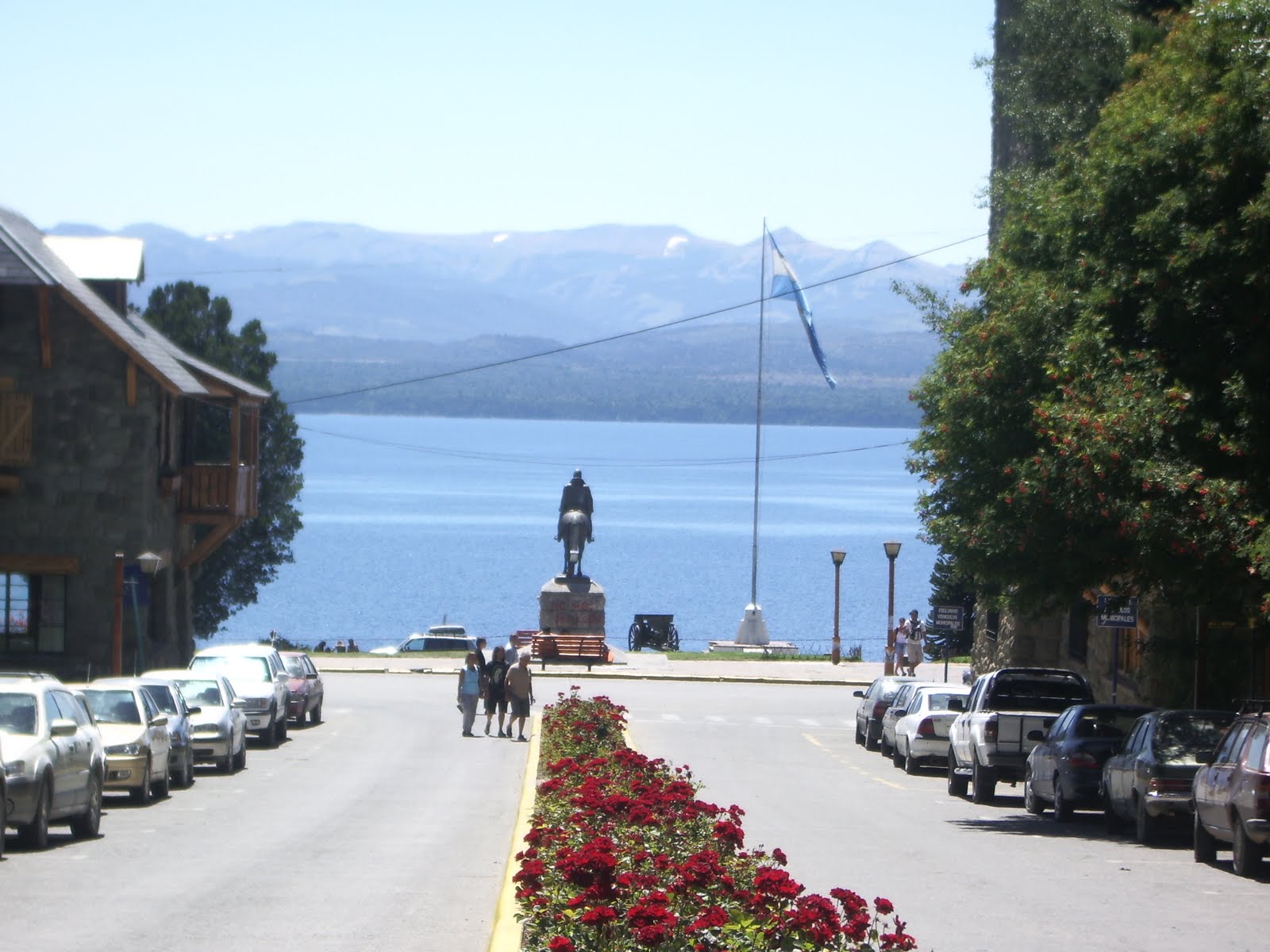
When we were in Argentina we loved the city of Bariloche. It is located in the southwestern part of Argentina near the Chilean border. It may have many claims to fame but for us it was a chocolate paradise. Since chocolate and Valentine’s Day are a perfect combination John and I often think of Bariloche at this time of year.

In the late 1800’s Austrians and Germans looking for a better life settled in the beautiful, fertile valley nestled in the Andes because it reminded them of their Bavarian homeland. Bariloche's chocolate history began after World War II, when some of the European immigrants began making chocolate at home. Today some of Bariloche's chocolates are still handmade but most are prepared by a combination of machines and handcrafting.

John and I dubbed Bariloche’s main street the “Street of Chocolate Dreams.” It is lined with stores selling chocolates with tourists trying to decide which store offers the best chocolate. It is a yummy dilemma! There was only one solution to the dilemma. John and I visited all the stores tasting samples from all the chocolatiers!

We started with a sample of milk chocolate at Franton’s small candy shop with a corner candy store ambiance and continued to Del Turista, a chocolate department store where the chef was creating Mousse de Chocolate. We watched as he spread the smooth creamy chocolate on the marble counter, waited a few minutes, then peeled off strips, which he curled and crowned the mousse. It looked so easy – and yummy!

Next stop was Fenoglio, a bit of the Black Forest in Bariloche. They claim it is the place where chocolate dreams become reality. Fenoglio is the original chocolate factory of Bariloche. It is where it all started more than 50 years ago. With a little bag of mint chocolates we walked to the next store.

At Boniface Chocolates, a small and friendly family store, they insisted we try one of their specialties – chocolate liquor. Truth be told it didn’t take much persuading. Chocolate with a little kick. We liked that!

La Mexicana Chocolates was one of our favorites. The saleslady, Martha, extolled the virtues of La Mexicana chocolates, “The company is still family run.

Next stop, grandmother’s. Abuela Goye is another family brand of chocolate. (Abuela is “grandmother” in Spanish). It is easy to find because of the life-size figure of “grandmother” stands outside the store enticing customers to enter and try the chocolate from “grandmother’s” own recipe.

I was intrigued by the huge matryoshka nesting doll display above the entrance to the Mamuschka Chocolate store. “Why a Russian name for a chocolate store in Argentina?” I asked the store manager. “No special reason except the owner loves the Russian nesting dolls.”

The final store was another chocolatier with a catchy name, Rapa Nui, which is the Polynesian name for Easter Island. Easter Island is part of Chile not Argentina; but again, it was just a favorite of the owner. We caught Maria Luz delivering a fresh batch of bonbons so, of course, we had to try them.

John and I headed to the Bariloche’s picturesque main plaza, gazed out over the tranquil lake, and had our lunch of chocolate. We each had a different favorite. I liked the caramel filled while John favored the dark solid chocolate. However, we both agreed it was all good.

Aug 26, 2010

What if Sustainable Tourism?


Sustainable tourism is similar to ecotourism that tries to protect the area’s natural environment but goes a step further to include the culture and other aspects of a location. To me it means to keep my tourist dollar in the local community and supporting the various aspects of the place I am visiting.

We often forget that our holidays are spent in other people’s homes and sometimes give little thought to the impact we have on our destination, its people, culture, economy, and environment. There are several easy ways to ensure the destination benefits from tourism.

Here are some things John and I try to do. We try to learn about the culture, politics and economy before we leave home. It always amazes us how much people know about our country and how little we know about theirs. We try to learn a few words such as “Hello” and “Thank You.” People really appreciate our feeble attempts to speak their language.

There are many ways to participate in the culture of an area. We like to participate in cooking experiences. Most cooking experiences share historical or cultural aspects of the food. “This is what we make to take to a neighbor if they have a death in the family,” we were told during a recent cooking experience in Turkey. We like to stay in really nice hotels but rarely eat dinner at the hotel. Usually the food has been internationalize and is expensive. We prefer to go to the small local cafes. My favorite places to buy food are the delis where the food is visible and is what the locals eat.

I am not a shopper but visiting local craftspeople helps to learn about the local economy and traditional handicrafts. By purchasing in markets and from vendors it keeps the money in the local economy and helps people keep their job. Bargaining is expected in many cultures, but it is easy to get carried away trying to find the best deal. We try to remember that small amounts of money to us could equal the cost of an entire family’s meal that night.

When we purchase tours we try to do it locally. In Cambodia we had an excellent afternoon tour of Angkor Wat by a local guide from an agency that is working to be as sustainable as possible. The tour included a visit to a local village and orphanage. It is not recommended to give money to beggars but giving to the local orphanages is an excellent way to get money directly to those in need.

John and I favor the Slow Travel concept. Our hurried concept of time is not the same in other cultures and local people’s patterns differ from our own. Try to do like the locals if only for a day. We sit in the parks and talk to the locals.

Sustainable tourism includes ecotourism so we are aware of our ecological footprint. We try to reuse water bottles, don’t buy wildlife products, turn off lights, and air conditioners.

We try to respect local cultures and contribute to intercultural understanding and tolerance. It is important to preserve the very things that make travel so interesting. Remember: Everyone smiles in the same language. The world is a fascinating place.